Confused by katha, bigha, shotok and decimal? This complete guide explains every land unit used in Bangladesh, how they convert to square feet, regional differences, and common mistakes to avoid when buying a plot.
Ask three people in Bangladesh how big a plot is and you may hear answers in katha, shotok, bigha, decimal or plain square feet. Land is the biggest purchase most families ever make, yet the units are a constant source of confusion, miscalculation and even disputes. This guide explains every common land measurement unit in Bangladesh, shows exactly how they relate to each other, and gives you simple methods — plus a free land unit converter — so you never get the numbers wrong again.
Need a quick answer?
Use our free tools: Katha to Shotok · Shotok to Bigha · Katha to Bigha · Land Area Calculator. Every result can be downloaded as a shareable photo card.
The quick answer: the standard conversion table
These are the values used in most deeds, housing projects and real-estate listings across Dhaka and other cities:
- 1 katha = 720 square feet (about 66.9 square metres)
- 1 shotok (decimal) = 435.6 square feet = 1/100 of an acre
- 1 bigha = 20 katha = 14,400 square feet (about 33.06 shotok)
- 1 acre = 100 shotok = 43,560 square feet (about 3.025 bigha, 60.5 katha)
- 1 gonda = 80 square feet (9 gonda = 1 katha)
- 1 chhatak = 45 square feet (16 chhatak = 1 katha)
- 1 hectare = 107,639 square feet = 247.1 shotok = about 7.5 bigha
From these, the most-searched conversions fall out directly: 1 katha = 1.6529 shotok, 1 shotok = 0.605 katha, 1 bigha = 33.06 shotok, 1 katha = 0.05 bigha. You can check any of them instantly with the katha to shotok converter or the shotok to katha converter.
Understanding each unit
Katha (কাঠা)
The katha is the everyday unit for residential plots in Dhaka, Chattogram and most towns. A plot is usually described as “3 katha” or “5 katha”. With 1 katha = 720 sq ft, a 5-katha plot is 3,600 sq ft — for example 60 ft × 60 ft. A typical road-facing 3-katha plot measures about 30 × 72 ft.
Shotok or decimal (শতক)
Shotok is the standard unit in land records — khatian, porcha, deed and mutation (namjari) documents — especially outside the cities. It is the Bengali name for the English decimal: exactly one hundredth of an acre. If your deed says “8.25 shotok”, that is 8.25 × 435.6 = 3,593.7 sq ft, or about 4.99 katha. See it worked out with the shotok to katha tool.
Bigha (বিঘা)
The bigha is used for larger agricultural and rural plots. In the commonly used system, 1 bigha = 20 katha = 14,400 sq ft. In many rural areas people instead treat 1 bigha as 33 shotok (14,374.8 sq ft) — the difference is tiny but can matter on a large parcel. Always check which definition applies before you agree on a price per bigha, and use the custom-size option in our bigha to shotok converter to match your area.
Acre, hectare and square feet
Acre and hectare appear in government projects, industrial land and large-scale development. Square feet and square metres are the language of architects and engineers — every building design, floor plan and construction estimate is in square feet. That is why converting your plot from shotok or katha into square feet is the first step of any construction project.
Why do the numbers differ from place to place?
Historically, the katha, bigha and related units were defined by local custom, not by a single national standard. Different districts used different rod lengths (nol) and different multiples. Modern practice in cities has settled around 720 sq ft per katha, but you may still meet:
- Older rural katha values that differ by a few percent from 720 sq ft;
- Bigha defined as 33 shotok instead of 20 katha;
- Mixed documents where the deed uses shotok but the seller quotes in katha.
The golden rule: trust the area written in the deed and khatian, and make the seller’s quoted katha match it. If a plot is advertised as “5 katha” but the deed says 7.5 shotok, that is only 4.54 katha (3,267 sq ft) — a difference of nearly half a katha that could be worth lakhs of taka in a prime area.
Step-by-step: how to measure your plot yourself
- Identify the shape. Rectangle, triangle, or four-sided irregular plot.
- Measure every side in feet with a measuring tape or a laser distance meter. For an irregular plot, also measure one diagonal.
- Compute the area. Rectangle: length × width. Triangle: Heron’s formula from the three sides. Four-sided: split with the diagonal into two triangles and add.
- Convert to katha and shotok. Divide square feet by 720 for katha, or by 435.6 for shotok.
- Compare with the deed. A small difference is normal; a large difference needs a licensed surveyor.
Our land area calculator does steps 2–4 for rectangles, triangles and four-sided plots, and shows the answer in katha, shotok, bigha and acre together.
Worked example
A plot measures 60 ft × 40 ft. Area = 2,400 sq ft. In katha: 2,400 ÷ 720 = 3.33 katha. In shotok: 2,400 ÷ 435.6 = 5.51 shotok. In bigha: 2,400 ÷ 14,400 = 0.167 bigha.
Common mistakes buyers make
- Confusing katha with shotok. A “10 shotok” plot is about 6 katha, not 10. Quoting the wrong unit changes the price by 65%.
- Ignoring the road or setback. Land that will be given up to a road or required as open space cannot be built on, so usable area may be less than the deed area.
- Comparing prices in different units. Always convert every offer to a common unit such as price per katha or per square foot. Our land price calculator shows all of them side by side.
- Forgetting extra costs. Registration, stamp duty, taxes and mutation add a significant percentage on top of the sale price.
- Assuming you can build on all of it. The buildable floor area depends on plot size, road width and ground coverage rules — not just land area.
From land area to building area
Once you know your plot size in square feet, you can estimate what you can build. In Dhaka, for example, permitted ground coverage and floor-area ratio depend on plot size and road width under the applicable building rules (verify with RAJUK or your city development authority). As a rough planning guide, many residential plots use about 60–70% of the land area at ground level; our construction cost estimator lets you try different coverage and floor counts to see an indicative construction cost and design fee range.
Before you build: the soil matters as much as the size
Two plots of identical size can need very different foundations. Soft clay, filled land or a high water table can multiply foundation cost or even change what can be built safely. Before paying for land, it is worth getting a quick geotechnical opinion — see our guide on why soil testing comes before design and our soil investigation and foundation design services.
Frequently asked questions
How many shotok in 1 katha?
1 katha = 1.6529 shotok (720 ÷ 435.6).
How many katha in 1 bigha?
20 katha in the standard system, i.e. 14,400 sq ft or about 33.06 shotok.
Is shotok the same as decimal?
Yes. Shotok is the Bangla term for decimal — 1/100 acre or 435.6 sq ft.
How many square feet in 1 acre?
43,560 square feet, which is 100 shotok, about 3.025 bigha or 60.5 katha.
Can I save or share my conversion?
Yes. Every tool on our free tools page creates a clean photo card of your result that you can download and send on WhatsApp or Messenger.
Key takeaways
- Standard values: 1 katha = 720 sq ft, 1 shotok = 435.6 sq ft, 1 bigha = 20 katha = 14,400 sq ft.
- Always convert every offer into one common unit before comparing prices.
- The area in the deed and khatian is what counts legally — verify with a surveyor for large differences.
- Land size is only half the story: soil conditions and building rules decide what and how you can build.
Disclaimer: This article is general information, not legal or survey advice. Local customs and rules vary — confirm with your lawyer, surveyor and the relevant authority.
Planning a project in Bangladesh?
Our specialist engineers apply exactly what this article covers to real projects — from structural & foundation design to 3D visualisation. See our completed projects.
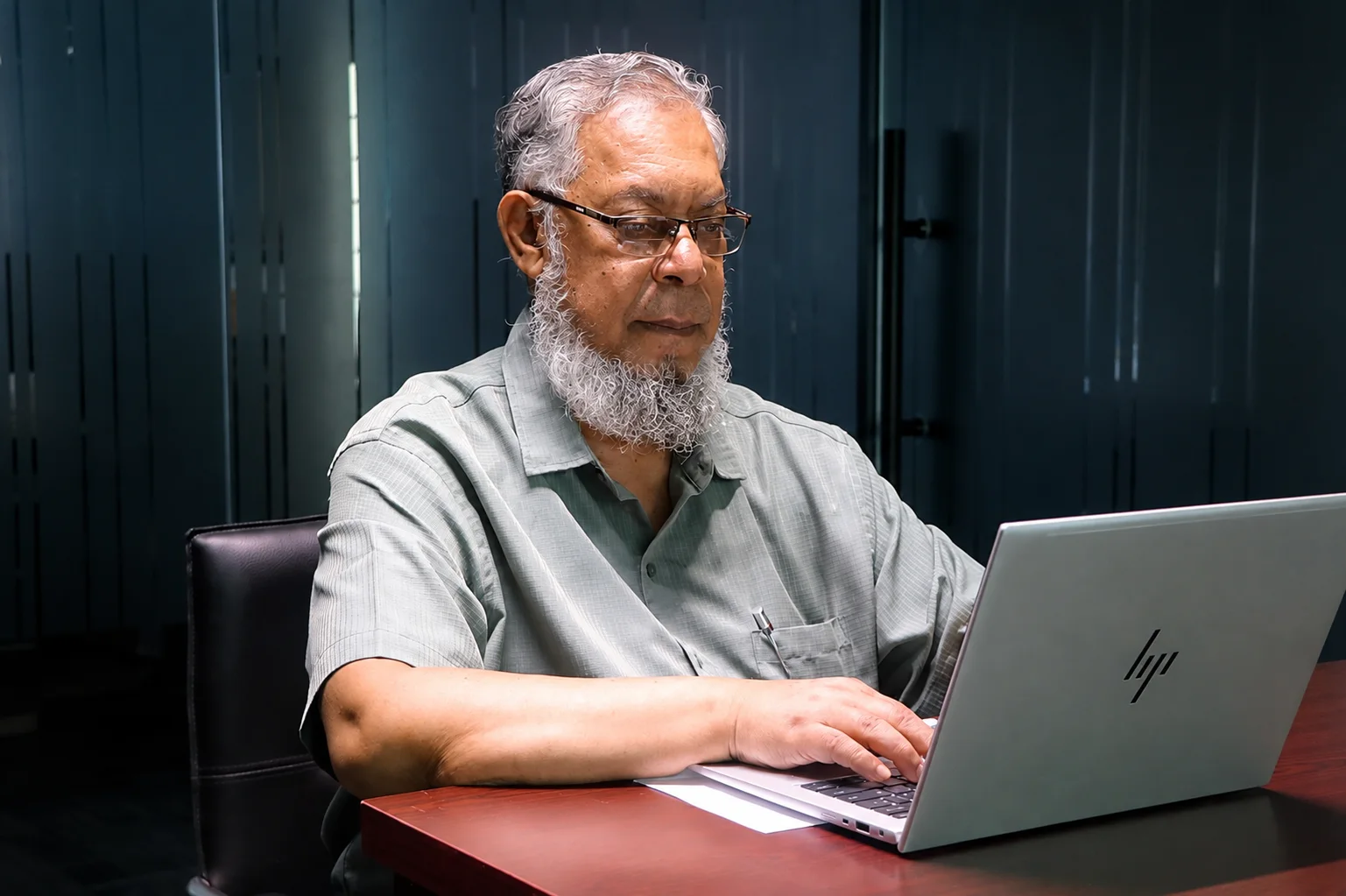
Prof. Dr. Ahasanul Kabir
Former Professor of Civil Engineering Department, BUET
This article was reviewed for technical accuracy by Prof. Dr. Ahasanul Kabir, ensuring it reflects sound engineering practice and Bangladesh National Building Code (BNBC) standards.